Showing posts with label hugh sinclair. Show all posts

Monday, 29 August 2011

Review: Graham Greene, 1936

 Hugh Sinclair and Nils Asther in The Marriage of Corbal, 1936
Graham Greene writing in The Spectator 5 June 1936:
What is an English film? There are times when one cannot help brooding with acute distress on the cheap silly international pictures exported under that label. The Marriage of Corbal is a fairly harmless example. It is incredibly silly and incredibly badly written but there is a kind of wide-eyed innocence about this story of the French revolution which is almost endearing. But an English film? Is that a fair description of a picture derived from a novel by Rafael Sabatini, directed by Karl Grune and F Brunn, photographed by Otto Kanturek, and edited by E Stokvis [sic] with a cast which includes Nils Asther, Ernst Deutsch and the American, Noah Berry? The result is appalling... England, of course, has always been the home of the exiled; but one may at least express a wich that émigrés would set up trades in which their ignorance of our language and our culture was less of a handicap; it would not grieve me to see Mr Alexander Korda seated before a cottage loom in an Eastern country, following an older and a better tradition. The Quota Act has played into foreign hands, and as far as I know, there is nothing to prevent an English film unit being completely staffed by technicians of foreign blood. We have saved the British film industry from American competition only to surrender it to a far more alien control.

Nils Asther: to Graham Greene's eyes in 1936, a distressing alien in the British film industry


The Cinematograph Films Act (1927) was introduced to stem the flood of American films into British cinemas. This protective legislation obliged exhibitors to programme a certain percentage of home-produced film. Intended to encourage quality filmmaking, the actual result of the Act was a plethora of short, cheap, quickly shot supporting features - 'quota quickies' - derided by critics at the time as a disgrace to British cinema. In retrospect, it can be seen that the 'quickies' provided a valuable training ground for filmmakers, technicians and actors who would later go on to greater things in 'quality' British cinema (including such notable figures as Michael Powell and David Lean). New legislation was introduced in 1938.


Thursday, 16 June 2011

Prisoner of Corbal (Marriage of Corbal) 1936


During the late 1930s, Nils Asther left Hollywood and spent some time in England and made three films there  - Abdul the Damned, 1935, in which he played a Turkish chief of police, Make Up, 1937, in which he played a European circus clown, and The Prisoner of Corbal, also known as The Marriage of Corbal, a historical romance in which he played a French revolutionary deputy.


The film hinges on the love triangle between a young aristocratic lady on the run (Cleonie, played by Hazel Terry), the murderous Varennes, Citizen-Deputy of the Revolution who saves her by disguising her as his nephew (Nils Asther) and finally the Marquis of Corbal of the film's title, played by Hugh Sinclair. 


Hazel Terry as Cleonie in disguise as the soldier-boy nephew
 of Nils Asther as Varennes, Citizen-Deputy of the Revolution
Hugh Sinclair as the Marquis of Corbal, Nils Asther as Varennes
Noah Beery as the Sergeant, Nils Asther as Varennes

On the whole, I had great fun watching this fluffy romance. The three leads are really good, and the ending had me on genuine tenterhooks. But it's a pretty creaky film, especially when it comes to dialogue with the minor characters, the echoey sound quality, and the couple of bizarre editing jump cuts that left me wondering at first if the film was incomplete.

The screenplay is from the book 'The Nuptials of Corbal' by Rafael Sabatini. As usual with adaptations, there's a whole load of back story that doesn't make it to the film, but this gives a satisfactory unspoken depth to the characters. Otherwise the story was a bit wooden.

Varennes enacts a crazy law ordering the populace of Corbal to marry - the 'Marriage of Corbal'
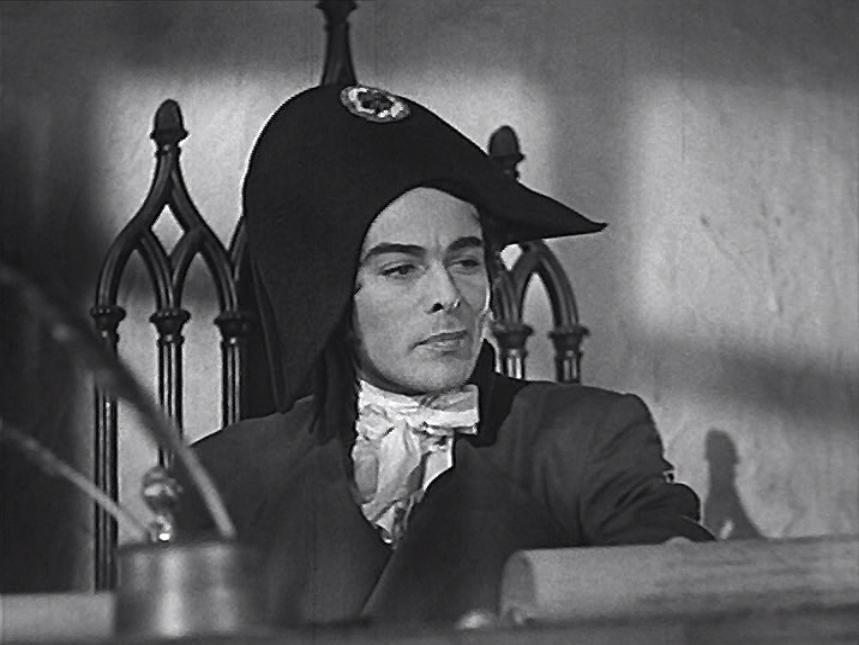
A fun courtroom scene where the two male leads do a bit of verbal sparring 
on the true nature of human liberty and citizenship and suchlike.
Nils Asther as the Citizen-Judge is devilish and twinkling as he attempts a rolling French accent.  Hugh Sinclair as the Marquis of Corbal, noble and terribly-English even though he's supposed to be a French nobleman. 


Amusingly, all of the French aristocrats, bar one, are played as if they are terribly decent Englishmen and women, apparently moral saints, and adored by their populace in a quite sickening way. The only exception to this noble=English rule is the one 'bad' French aristocrat, Ernst Deutch, who not only played by an Austrian, but is nasty to his peasants, so boo to him.

In a similar vein, the rabble of French revolutionaries are acted by foreigners, ie the Swedish Asther and the American Noah Beery. With the benefit of so many years' distance, the xenophobia is so glaring it's funny. 

The film's main saving grace is that the baddies develop throughout the film with surprisingly intelligent moral shading. Varennes is noble in unexpected places. His sargeant is as loyal as his conscience will allow. In the end, it is these plot twists provided by their complex characters that kept me interested.

The DVD I watched was a nicely restored version by Reknown pictures from 2009 and can be purchased here.

The Marquis of Corbal and Varennes go head to head again
 
Varennes gives an impassioned speech about the fallen of the 
revolution to Cleonie - some old-fashioned but magnetic 
silent-movie style acting from Asther
Varennes tries to coax Cleonie into confessing her regard for him