
Nils Asther, signed publicity still for The Marriage of Corbal, 1936, an English-financed film in which he played Varennes, Citizen-Deputy of the French revolution
Showing posts with label nils asther in england. Show all posts
Showing posts with label nils asther in england. Show all posts
Wednesday, 14 September 2011


Friday, 26 August 2011
Picture of the day: this one's huge

Nils Asther, English card.
Unknown photographer, I'd guess a promotional studio shot taken in the late 1920s. (On further research the photo is by Irving Chidnoff, New York.)
Unknown photographer, I'd guess a promotional studio shot taken in the late 1920s. (On further research the photo is by Irving Chidnoff, New York.)
Click on the photos and you'll see them a lot bigger and more beautiful.


This card is similar and marked United Artists.
In 1927, Asther left Europe for America.
He was in London when his 1926 German film, Der Goldene Schmetterling, was seen in Hollywood and he was offered contracts.
At first he made Sorrell and Son in England for United Artists. Then they invited him to come over. It seems he stopped off in New York to have these photos taken before he arrived.
United Artists were not the first studio with which Asther had signed. At first he accepted a contract with Paramount. "A few days later came an offer from United Artists," he told Katherine Albert in Photoplay, 1929. "I explained that I was already signed and they bought the first contract. Other studios offered me contracts, as well."
Friday, 8 July 2011

Thursday, 16 June 2011
Prisoner of Corbal (Marriage of Corbal) 1936


The film hinges on the love triangle between a young aristocratic lady on the run (Cleonie, played by Hazel Terry), the murderous Varennes, Citizen-Deputy of the Revolution who saves her by disguising her as his nephew (Nils Asther) and finally the Marquis of Corbal of the film's title, played by Hugh Sinclair.

Hazel Terry as Cleonie in disguise as the soldier-boy nephew
of Nils Asther as Varennes, Citizen-Deputy of the Revolution


Hugh Sinclair as the Marquis of Corbal, Nils Asther as Varennes

Noah Beery as the Sergeant, Nils Asther as Varennes


On the whole, I had great fun watching this fluffy romance. The three leads are really good, and the ending had me on genuine tenterhooks. But it's a pretty creaky film, especially when it comes to dialogue with the minor characters, the echoey sound quality, and the couple of bizarre editing jump cuts that left me wondering at first if the film was incomplete.
The screenplay is from the book 'The Nuptials of Corbal' by Rafael Sabatini. As usual with adaptations, there's a whole load of back story that doesn't make it to the film, but this gives a satisfactory unspoken depth to the characters. Otherwise the story was a bit wooden.

Varennes enacts a crazy law ordering the populace of Corbal to marry - the 'Marriage of Corbal'

A fun courtroom scene where the two male leads do a bit of verbal sparring
on the true nature of human liberty and citizenship and suchlike.

Nils Asther as the Citizen-Judge is devilish and twinkling as he attempts a rolling French accent. Hugh Sinclair as the Marquis of Corbal, noble and terribly-English even though he's supposed to be a French nobleman.


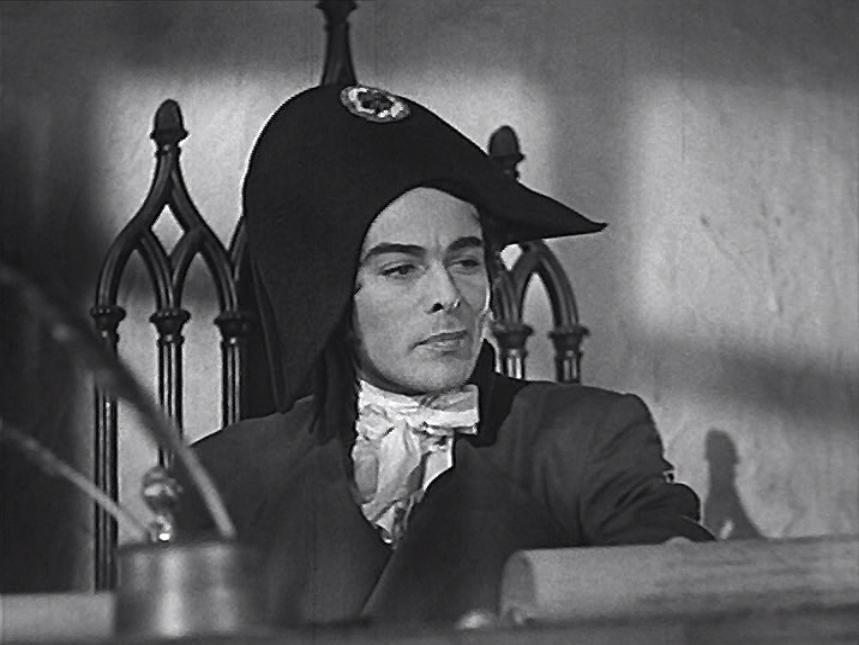
Amusingly, all of the French aristocrats, bar one, are played as if they are terribly decent Englishmen and women, apparently moral saints, and adored by their populace in a quite sickening way. The only exception to this noble=English rule is the one 'bad' French aristocrat, Ernst Deutch, who not only played by an Austrian, but is nasty to his peasants, so boo to him.
In a similar vein, the rabble of French revolutionaries are acted by foreigners, ie the Swedish Asther and the American Noah Beery. With the benefit of so many years' distance, the xenophobia is so glaring it's funny.
The film's main saving grace is that the baddies develop throughout the film with surprisingly intelligent moral shading. Varennes is noble in unexpected places. His sargeant is as loyal as his conscience will allow. In the end, it is these plot twists provided by their complex characters that kept me interested.
The DVD I watched was a nicely restored version by Reknown pictures from 2009 and can be purchased here.

The Marquis of Corbal and Varennes go head to head again


Varennes gives an impassioned speech about the fallen of the
revolution to Cleonie - some old-fashioned but magnetic
silent-movie style acting from Asther


Varennes tries to coax Cleonie into confessing her regard for him

Subscribe to:
Posts (Atom)