Showing posts with label film review. Show all posts

Wednesday, 19 October 2011

The Blue Danube (Honor Above All) 1928

Nils Asther, promotional card for Honor Above All (The Blue Danube), 1928

In this silent romantic melodrama, Asther plays Erich von Statzen, a young Hungarian baron who is called away to WWI on the eve of his wedding day to Marguerite (Leatrice Joy). Marguerite is then left alone to fend off the lies peddled by Ludwig, an elderly violin maker, who tries to convince her that the baron has been unfaithful and she should marry him instead.

Cecil B D Mille was executive producer and a copy of this film is kept in the Library of Congress.


Leatrice Joy and Nils Asther
Ludwig (Joseph Schildkraut) has eyes for tavern girl Marguerite (Leatrice Joy)


April 30, 1928

'BLUE DANUBE' IS SHOWN; Film at the Strand Employs Girl and-Hunchback Theme.

This picture is another reiteration of the sentimental Marguerite theme, made a bit more pleasant than most by the actors in the three leading rôles.

Like its sisters, which are legion, the plot concerns itself with Marguerite, the daughter of an innkeeper, the baron of the district and the village hunchback. The baron and the girl fall in love while the orchestra plays "The Blue Danube" Waltz, but before they can be married the young man departs for war. He tries to send messages back by Ludwig, the hunchback, but they never arrive. An uncle of the baron complicates matters by forcing Marguerite to marry Ludwig. It ends cheerfully, with the hunchback stabbing himself, and the girl and her baron falling into each other's arms.

Miss Joy has the chief rôle and manages to instill a manner into the threadbare character which makes it not only graceful but intelligent. Her baron, Mr. Asther, ranges quite well from tenderness to bravery without losing his stride in the process.

About Mr. Schildkraut, in the difficult part of Ludwig the hunchback, there is something of Germanic symbolism. Ludwig is by trade a violin maker and as he sits and meditates on his love and on his wrongs, the knife and small hammer are never idle. His eyes stare fitfully, changing from sorrow to the glare of intense hatred.

There are in the picture certain bits of good direction—things fading out and merging into others of similar nature. Many ideas are suggested lightly rather than being heavily painted in the "stop-go" manner.

Promotional sheet music for the film 


Poster Tagline: "DECEIVED by those she trusted, she became the spite-bride of the creature she loathed. Don't fail to see this, the most enthralling love romance ever screened."


Monday, 29 August 2011

Review: Graham Greene, 1936

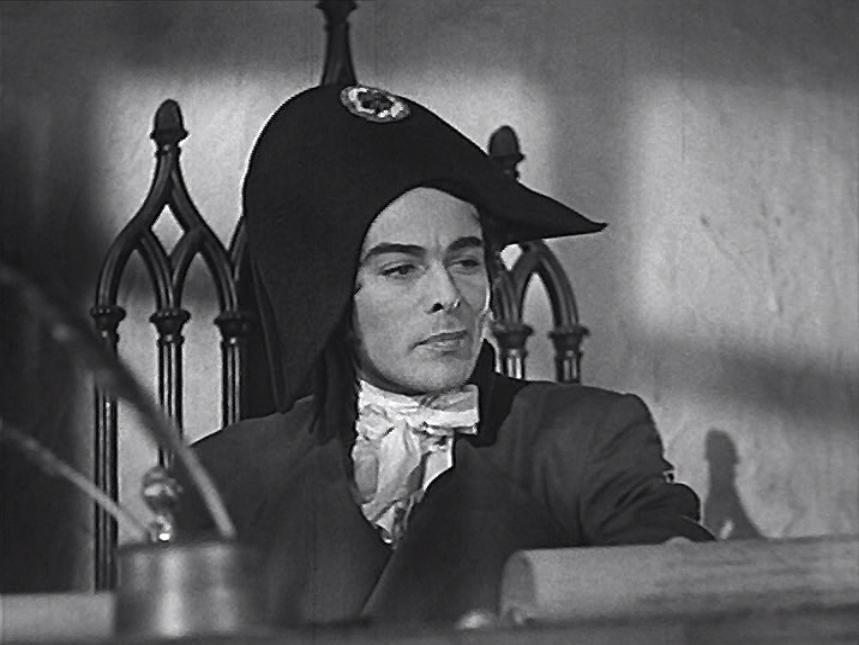
 Hugh Sinclair and Nils Asther in The Marriage of Corbal, 1936
Graham Greene writing in The Spectator 5 June 1936:
What is an English film? There are times when one cannot help brooding with acute distress on the cheap silly international pictures exported under that label. The Marriage of Corbal is a fairly harmless example. It is incredibly silly and incredibly badly written but there is a kind of wide-eyed innocence about this story of the French revolution which is almost endearing. But an English film? Is that a fair description of a picture derived from a novel by Rafael Sabatini, directed by Karl Grune and F Brunn, photographed by Otto Kanturek, and edited by E Stokvis [sic] with a cast which includes Nils Asther, Ernst Deutsch and the American, Noah Berry? The result is appalling... England, of course, has always been the home of the exiled; but one may at least express a wich that émigrés would set up trades in which their ignorance of our language and our culture was less of a handicap; it would not grieve me to see Mr Alexander Korda seated before a cottage loom in an Eastern country, following an older and a better tradition. The Quota Act has played into foreign hands, and as far as I know, there is nothing to prevent an English film unit being completely staffed by technicians of foreign blood. We have saved the British film industry from American competition only to surrender it to a far more alien control.


Nils Asther: to Graham Greene's eyes in 1936, a distressing alien in the British film industry


The Cinematograph Films Act (1927) was introduced to stem the flood of American films into British cinemas. This protective legislation obliged exhibitors to programme a certain percentage of home-produced film. Intended to encourage quality filmmaking, the actual result of the Act was a plethora of short, cheap, quickly shot supporting features - 'quota quickies' - derided by critics at the time as a disgrace to British cinema. In retrospect, it can be seen that the 'quickies' provided a valuable training ground for filmmakers, technicians and actors who would later go on to greater things in 'quality' British cinema (including such notable figures as Michael Powell and David Lean). New legislation was introduced in 1938.


Sunday, 10 July 2011

Loves of An Actress, Pola Negri, 1928


Loves of an Actress, 1928, starring Pola Negri, Nils Asther and Mary McAllister is a a lost film - all surviving prints are gone and with it, the plot, except what can be gleaned from promotional stills, cinema posters and contemporary reviews. 

By 1928, when it was made, the era of silent pictures was coming to an end. Loves of an Actress did not have what we we would nowadays call a soundtrack - instead smatterings of sound effects were played at certain moments, like a baby's cry or animal noises.


1928 review  of Loves of An Actress, from the New York Times: 
Pola Negri's latest offering seems to prove that there is, after all, a day of atonement for the errors of youth. Unfortunately, however, "Loves of an Actress," despite the enchantment of the plural, can be called only another motion picture. 
The background or the play is France in the middle of the last century. Miss Negri takes the part of an actress who has risen to being the toast of Paris—risen chiefly through her affairs with three important gentlemen—a banker, a newspaper owner and a count. 
It inevitably happens that at the height of her career she falls in love with a young man who is soon to become an Ambassador to Russia. Two of her former gentlemen friends grin and bear it; the third states sullenly that he loves her still. To prove it, he threatens to publish her letters in the columns which previously had been devoted to praising her acting. 
The actress, Rachel, first of all dares him to go ahead, but on sober second thought she realizes that not only will that be the end of her career but it will ruin her fiancé's as well. She breaks the engagement. Not long afterward she dies of a broken heart—first, however, playing a death scene in such a manner as to wring the greatest praise from her public. 
The chief trouble with "Loves of an Actress" is that it is too long. The story is not new, and as there is no suspense it all comes down to a question of waiting for the expected to happen. And then it develops so slowly as to be a little tiresome.
There are scenes scattered here and there, however, which show Miss Negri's acting ability to good advantage. She gives a good portrait of an actress—if not necessarily of midnineteenth century France—and her relationships with her several admirers are well done. Nils Asther, as Raoul—the man she loves—cannot quite curb a tendency to overact his part; otherwise the supporting cast is acceptable. 
"Loves of an Actress" demonstrates ad absurdam the potentialities of synchnorization. The varied noises taking part in the action of the picture range from the squealing effect when a baby is shown crying through sundry barnyard effects early one morning to vocal selections. An orchestra in the pit would have been better. 
On the stage there is Paul Ash and the Paramount Orchestra exploiting Broadway. They are assisted by Fred Bernard, Helen Honan, the Collette Sisters, Sally Starr, Du Calion and some Gamby-Hale Girls.
Music score for the film's hit song, Sunbeams (bring dreams of you)

Film stills from AliceJapan on flickr

 Promotional stills for the film 
 Mary McAllister and Nils Asther

Pola Negri and Nils Asther

Cigarette cards promoting the film - these were included in packs by tobacco companies
 

Saturday, 2 July 2011

Laugh, Clown, Laugh (1928)

Laugh, Clown, Laugh is a silent movie from 1928 starring Lon Chaney, Loretta Young and Nils Asther.

IMDb: As professional clowns Tito and Simon are traveling, they happen upon an abandoned child, whom they take in and name Simonetta. When Simonetta is older, she becomes a circus performer herself. One day she is looking for roses, and climbs into the garden of Count Luigi Ravelli. The count becomes infatuated with her, but she leaves as soon as possible. 
Sometime later, Ravelli consults a doctor about his fits of uncontrollable laughter, and there he meets Tito, who has come to seek help for his fits of uncontrollable weeping. The two decide to help each other, and they establish a friendship, but problems arise when they realize that they are both in love with Simonetta.
 

scenes with Nils Asther from the film

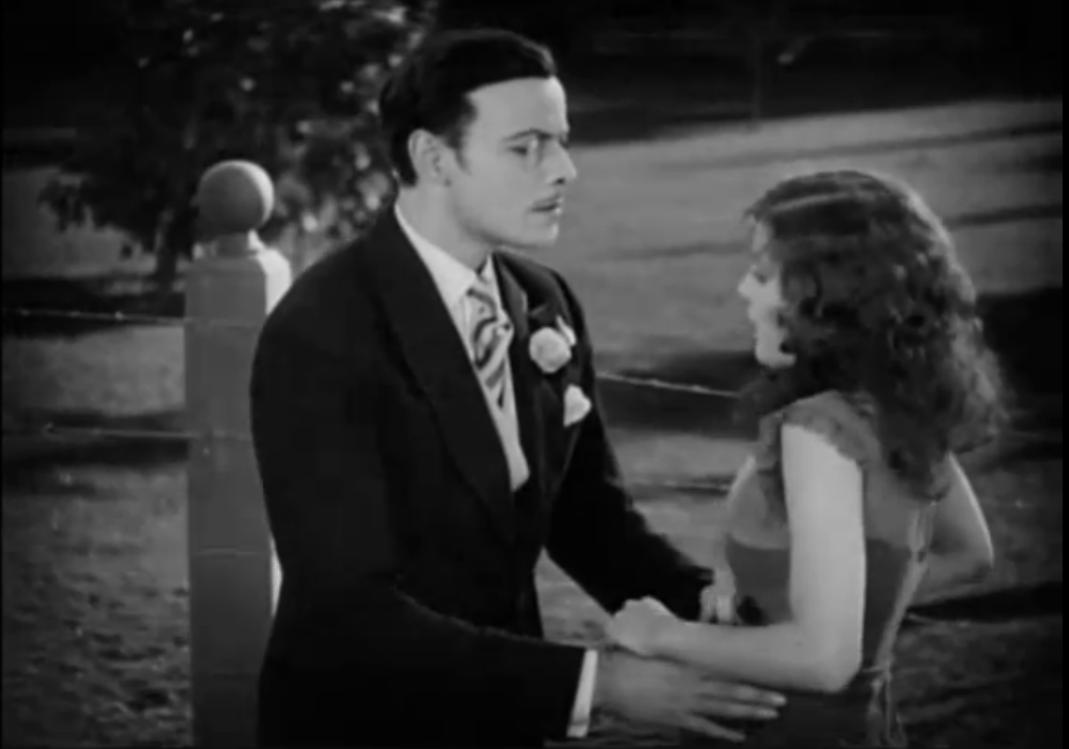
Count Luigi Ravelli (Asther) spies someone in his rose garden.
It's lovely Simonetta (Loretta Young), and the Count lifts her from the fence.
He has rather busy hands.
He wraps his handkerchief round Simonetta's cut.
Then he tries to place a rose somewhere a gentleman has no business being.
But Simonetta keeps him out of her nubbies and holds the bloom instead.
Ahem.
The Count takes her to his house, and straight to his bedroom.
He lifts her onto the bed. Some astonishingly blatant groping goes on here.
For something really quite chaste, this is 
one of the most sexually charged things I've ever seen.
For those into feet, this scene will make you happy.

"What a lovely child of nature you are! What an alluring woman you could be!" 
They are interrupted.
"Send that peasant away!" 
"No."
 The lady spits hellfire. The Count rushes to soothe. 
Simonetta is shocked at the situation and escapes out a window.
With the competition gone, the lady lets herself be pushed her out the door.
But the lovely Simonetta has gone. The Count begins to laugh compulsively.

* the years pass *

The Count seeks out help because of his uncontrollable giggling.
At the doctor he meets Tito, Simonetta's adopted father, who keeps crying.
The doctor suggests to Count Luigi that he will be cured if he falls in love.
Then the doctor says the same to Tito... I get the feeling it's his fallback diagnosis.


Luigi and Tito talk together on the balcony.
"You mean, you can't help laughing  -"
" - any more than I can help crying?"
Hey, whatever works.

Simonetta arrives. She is advised to help Tito be more social for his condition. Tito insists the three of them leave the doctor's arm in arm together. 
They spend time together and go for a carriage drive.
But then Tito discovers the Count has given Simonetta some expensive pearls. 
He accuses him of having improper designs.
The count shows Tito a proposal of marriage included with the necklace.
Flik nobly gives the Count his blessing, 
even though he loves Simonetta himself.
Simonetta still believes the Count is trifling after her past experience.
After he proposes she realises he is serious, and consents. Tito is heartbroken.
Count Luigi and Simonetta spend time together.
"Oh Luigi, I could be so happy, if only Tito were not  - alone. 
Can't we have him near us? He seems so helpless - ."
"Of course, dear. We need him too. He seems almost part of us."

that's the end of the scenes with Nils Asther


also, check out these blog entries about Laugh, Clown, Laugh: